
|

Modelling collective navigation via non-local communication

A recent paper called “Modelling collective navigation via non-local communication”
has been published by S. T. Johnston(1) and K. J. Painter(2).

They tell us that a group of individuals produce better navigational results than
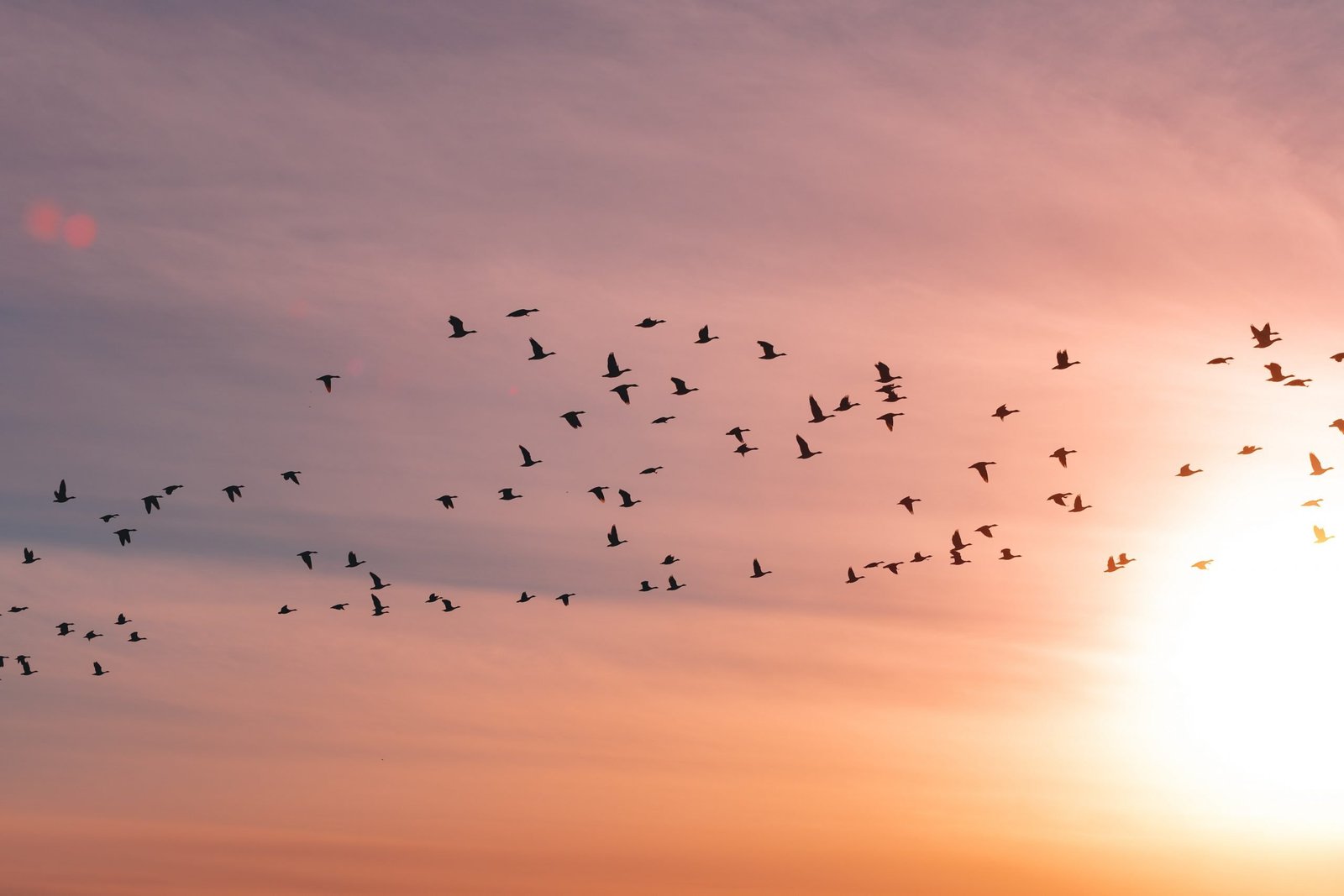
individuals which is why flocks of birds are more efficient than a solo migrant. The
RAF confirms this where they have found that a more than one navigator does
a better job.

Collective migration occurs throughout the animal kingdom, and demands both the
interpretation of navigational cues and the perception of other individuals within the
group. Navigational cues orient individuals towards a destination, while it has been
demonstrated that communication between individuals enhances navigation through
a reduction in orientation error.

We develop a mathematical model of collective navigation that synthesises navigational cues and perception of other individuals. Crucially, this approach incorporates uncertainty inherent to cue interpretation and perception in the decision making process, which can arise due to noisy environments.

We demonstrate that collective navigation is more efficient than individual navigation, provided a threshold number of other individuals are perceptible. This benefit is even more pronounced in low navigation information environments. In navigation ‘blindspots’, where no information is available, navigation is enhanced through a relay that connects individuals in information- poor regions to individuals in information-rich regions. As an expository case study, we apply our framework to minke whale migration in the northeast Atlantic Ocean, and quantify the decrease in navigation ability due to anthropogenic noise pollution.

1 Systems Biology Laboratory, School of Mathematics and Statistics, and Department of Biomedical Engineering, University of Melbourne, Parkville, Victoria 3010, Australia
2 Dipartimento Interateneo di Scienze, Progetto e Politiche del Territorio (DIST) Politecnico di Torino, Viale Pier Andrea Mattioli, Torino 39 10125, Italy

Similar Posts

  • Murmuration

    http://vimeo.com/31158841 This video shows the amazing whorls and patterns made by a flock of starlings.  You might see these over cities.  These displays used to be common over London, and I think still are over Rome. Whilst there has been much scientific research and theories on why starlings do this, the contention is that the…

  • Emperor Penguins

    I have always been fascinated and touched by the devotion of Emperor Penguins and their rearing of a single chick in possibly the remotest and severest of environments on the planet. They breed in the depth of the Antarctic winter during 24 hours of darkness in temperatures which range from –20 C to – 50C…

  • Albatross dynamic soaring

    Please find this PDF which follows a lot of research on Albatrosses.  This presentation throws up some really interesting issues.  I feel comfortable that albatrosses when they decide to go home follow their sense of direction to their home islands in the South Atlantic: the Crozet Islands and Kerguelen as they fly straight there. However, please…

  • Bird Navigation

    I was delighted to be able to attend the animal navigation conference at Reading University in May 2008. I attended as a dowser with the theory that animals can and do follow dowsable clues including earth energy lines as an aid to navigation. We all know that dowsers (water diviners) can find water.  However what…

  • Bar headed goose

    Recent work at Bognor University by a team headed by Charles Bishop has shown they actually follow the contours as they fly from their breeding ground in the high lakes North of the Himalayas south over the Himalayas into the Indian sub continent See wikipedia for images and an overview http://en.wikipedia.org/wiki/Bar-headed_goose This is an interesting…

  • Navigation Networks in the Brain

    Professor Kate Jeffery of University College London gave the annual address to the Royal Institute of Navigation (RIN) this year (2014). This article published in RIN’s Navigation News is, for me, a seminal step forward in describing the parameters of animal navigation and building a structure to delve deeper into how navigation might work. Her idea that…